Paper: ‘Sequence variation, evolutionary constraint, and selection at the CD163 gene in pigs’

This paper is sort of a preview of what is going to be a large series of empirical papers on pig genomics from a lot of people in our group.

The humble CD163 gene has become quite important, because the PRRS virus exploits it to enter macrophages when it infects a pig. It turns out, that if you inactivate it — and there are several ways to go about that; a new one was even published right this paper (Chen et al. 2019) — you get a PRRSV-resistant pig. For obvious reasons, PRRSV-resistant pigs would be great for pig farmers.

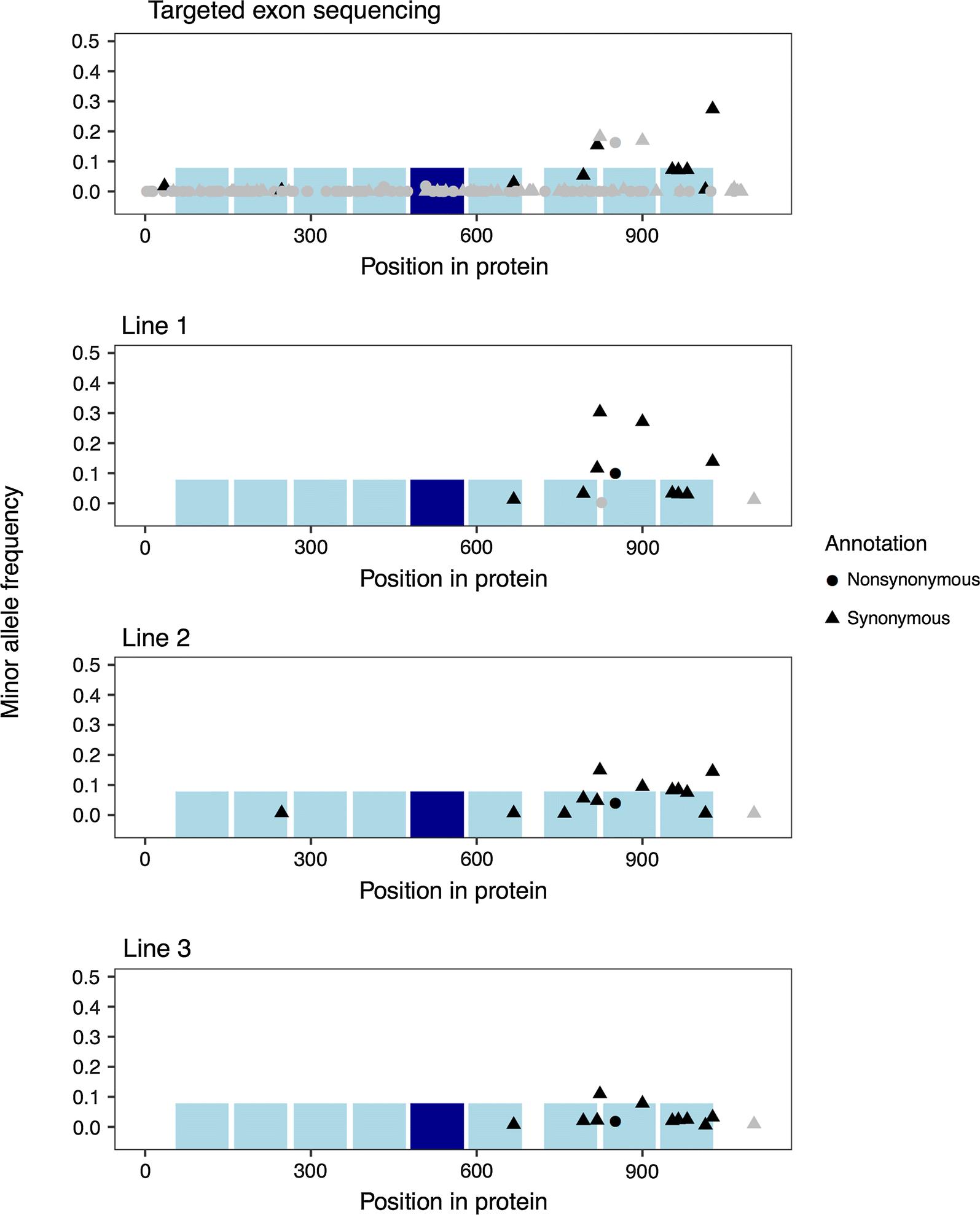
In this paper, we wanted to figure out 1) if there were any natural knockout variants in CD163, and 2) if there was anything special about CD163 if you compare it to the rest of the genes in the pig genome. In short, we found no convincing knockout variants, and that CD163 seemed moderately variant intolerant, under positive selection in the lineage leading up to the pig, and that there was no evidence of a selective sweep at CD63.

You can read the whole thing in GSE.

Figure 1, showing sequence variants detected in the CD163 gene.

If you are so inclined, this might lead on to the interesting but not very well defined open question of how we combine these different perspectives on selection in the genome, and how they go together with other genome features like mutation rate and recombination rate variation. There are some disparate threads to bring together there.

Johnsson, Martin, et al. Sequence variation, evolutionary constraint, and selection at the CD163 gene in pigs. Genetics Selection Evolution 50.1 (2018): 69.

Paper: ‘Integrating selection mapping with genetic mapping and functional genomics’

If you’re the kind of geneticist who wants to know about causative variants that affect selected traits, you have probably thought about how to combine genome scans for signatures of selection with genome-wide association studies. There is one simple problem: Unfortunately, once you’ve found a selective sweep, the association signal is gone, because the causative variant is fixed (or close to). So you need some tricks.

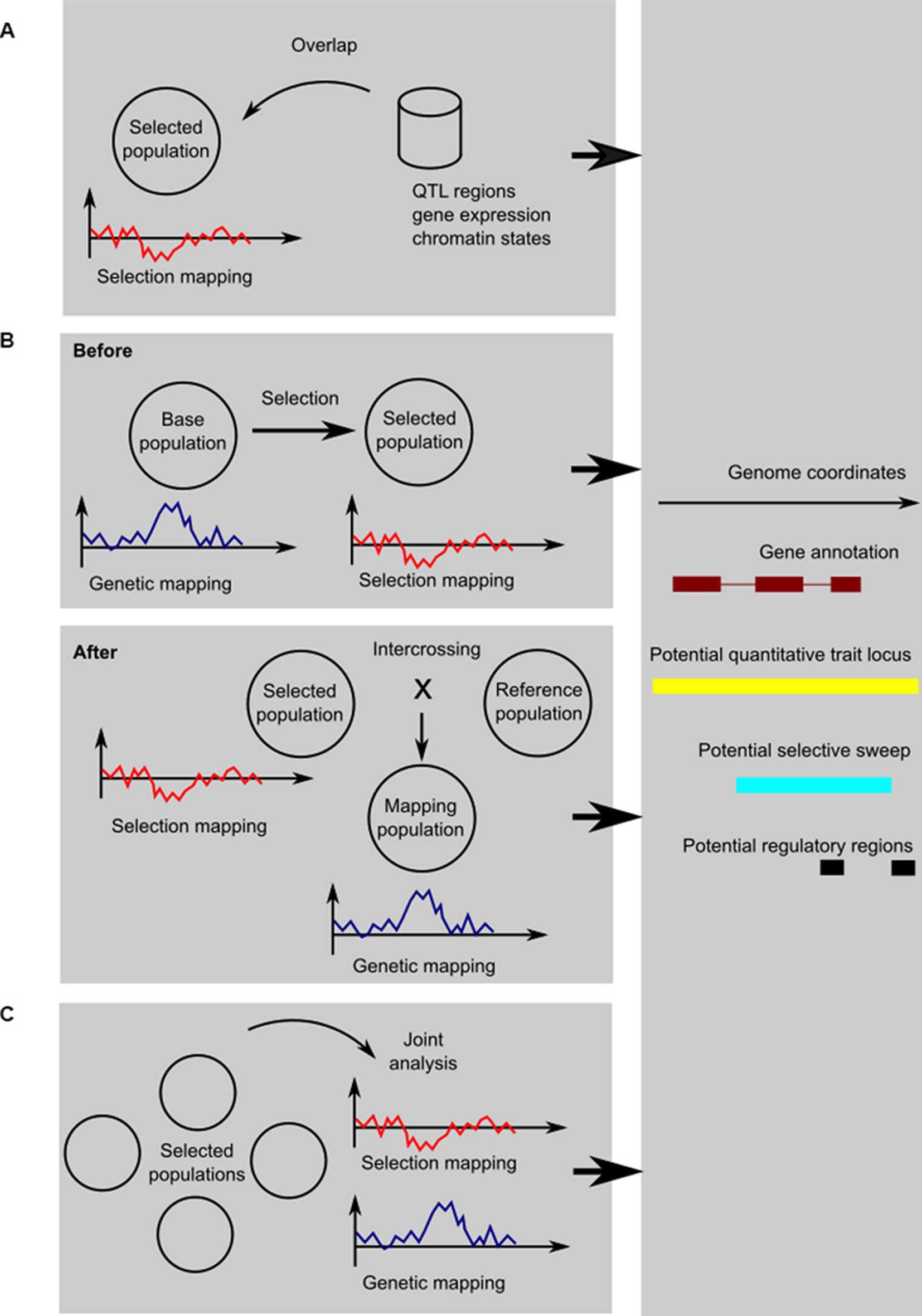
This is a short review that I wrote for a research topic on the genomics of adaptation. It occurred to me that one can divide the ways to combine selection mapping and genetic mapping in three categories. The review contains examples from the literature of how people have done it, and this mock genome-browser style figure to illustrate them.

You can read the whole thing in Frontiers in Genetics.

Johnsson, Martin. Integrating selection mapping with genetic mapping and functional genomics. Frontiers in Genetics 9 (2018): 603.

”Gener påverkar” ditt och datt

Det var länge sedan jag skrev en post som den här, men en gång i tiden bestod bloggen nästan helt av gnäll på avsaknad av referenser i nyhetsartiklar om vetenskap. Delvis var det ett sätt att lägga till referenser till nyhetsartiklarna, för om en bloggpost länkade till en artikel i till exempel DN så svarade de med en länk på artikeln. Det känns som det var oskyldigare tider när tidningar tyckte det var rimligt att automatiskt länka till bloggar som skrev om dem.

Nåväl. Det börjar så här: en vän skickar en länk till den här artikeln på SVT Nyheter Uppsalas hemsida: ”Dina gener påverkar hur ditt fett lägger sig” Det är en notis med anledning av en ny vetenskaplig artikel från forskare i Uppsala. Den har till och med en liten video. Det står:

En ny studie gjord på Uppsala universitet visar att dina gener påverkar var ditt fett hamnar på kroppen.

360 000 personer har deltagit i studien, och studien kan visa att det främst är kvinnor som påverkas av sin genetik.

– Vi vet att kvinnor och män tenderar att lagra fett i olika delar av kroppen. Kvinnor har lättare för att lagra fett på höfter och ben, medan män i högre utsträckning lagrar fett i buken, säger Mathias Rask-Andersen vid institutionen för genetik vid Uppsala universitet.

Och inte så mycket mer. Min vän skriver ungefär: Men det här vet man väl ändå redan, att det kan finnas någon genetisk effekt på hur fett fördelar sig på kroppen? Det måste ligga något mer bakom forskningen som kommit bort i nyhetsartikeln. Och det gör det förstås.

Nu behöver vi hitta originalartikeln. Det finns ingen referens i nyhetsartikeln, men de har i alla fall hjälpsamt nämnt en av forskarna vid namn, så vi har lite mer information än att det är någon kopplad till Uppsala. Jag börjar med att söka efter Mathias Rask-Andersen. Först kollar jag hans Google Scholar-sida, men där finns artikeln inte än. Helt nya artiklar brukar ta en stund på sig att komma in i litteraturdatabaser. Sedan hans och forskargruppens sidor på Uppsala universitet, men de är förstås inte heller uppdaterade än. Eftersom nyhetsartikeln nämnde 360 000 individer kan vi gissa att de förmodligen använde data från UK Biobank, så vi kan titta på deras publikationssida också. Där finns nästan löjligt många artiklar som redan publicerats 2019, men inte den här.

Först efter det kommer jag på att titta på Uppsala universitets pressida efter det fullständiga pressmeddelandet. Bingo. Det innehåller en referens till artikeln i Nature Communications. Här är den: Rask-Andersen et al. (2019) Genome-wide association study of body fat distribution identifies adiposity loci and sex-specific genetic effects.

”Genome-wide association study”, står det — associationsstudie på hela genomet. Det rör sig alltså om en associationsstudie, det vill säga en studie som försöker koppla fettfördelningen till vissa genetiska varianter. Man dna-testar en massa människor och ser vilka genetiska varianter som hänger samman med att ha fettet på ett visst ställe på kroppen. (Här en mycket gammal bloggpost som försöker beskriva detta.)

Det handlar alltså inte om forskning som försöker pröva om fettfördelningen har någon genetisk grund eller inte, utan forskning som givet att fettfördelningen på kroppen har en viss genetisk grund försöker ta reda på vilka gener och genetiska varianter som påverkar. Nyhetsartikeln har alltså fått vad studien handlar om helt om bakfoten, och så här brukar det se ut när associationsstudier presenteras i media. De framställs som något som ska testa om ”gener påverkar” något eller inte. Hur kommer det sig?

Jag misstänker att associationsstudier är för svåra att beskriva kortfattat i ett pressmeddelande. Det är lättare att säga att studien visar ”att gener påverkar” än att den ”försöker hitta just de varianter av gener som påverkar”, och därför blir det vad forskaren eller kommunikatören på universitetet skriver i sitt pressmeddelande. Sedan klipper reportern ner pressmeddelandet till hanterbar längd, och då försvinner de flesta detaljer samt referensen till originalartikeln.

Så kommer det sig att nyhetsartiklar om nya associationsstudier ger helt missvisande beskrivningar av vad de handlar om.

Journal club of one: ‘Splendor and misery of adaptation, or the importance of neutral null for understanding evolution’

In this paper from a couple of years ago, Eugene Koonin takes on naïve adaptationism, in the style of The Spandrels of Saint Marcos and the Panglossian paradigm (Gould & Lewontin 1979). The spandrels paper is one of those classics that divide people. One of its problems was that it is easy to point out what one shouldn’t do (tell adaptive stories without justification), but harder to say what one should do. But anti-adaptationism has moved forward since the Spandrels, and the current paper has a prescription.

Spandrels contained a list of possible alternatives to adaptation, which I think breaks down into two categories: population genetic alternatives (including neutral or deleterious fixations due to drift and runaway selection driving destructive features rather than fit to the environment), and physiological or physical alternatives (features that arise due to selection on something else, which are the metaphorical spandrels of the title, and fit to the environment that happens due to natural laws unrelated to biological evolution).

Eugene Koonin elaborates on the population genetic part, concentrating more on chance and less on constraint. He brings up examples of molecular structures that may have arisen through neutral evolution. The main idea is that when a feature has fixed, it doesn’t go away so easily, and there can be a ratchet-like process of increasing complexity. Evolution doesn’t Haussmannise, but patches, pieces, and cobbles together what is already there.

As a theoretical example, Michael Lynch (2007) used population genetic models to derive conditions for when molecular networks can extend and become complex by neutral means. (Spoiler: it’s when transcription factor binding motifs arise often in the weakly constrained DNA around genes.) Eugene Koonin thinks that the thing to do with this insight is to use it as a null model:

A simplified and arguably the most realistic approach is to assume a neutral null model and then seek evidence of selection that could falsify it. Null models are standard in physics but apparently not in biology. However, if biology is to evolve into a ”hard” science, with a solid theoretical core, it must be based on null models, no other path is known.

I disagree with this for two reasons. I’m not at all convinced that biology must be based on setting up null models and rejecting them … or that physics is. In some statistical approaches, inference proceeds by setting up a null hypothesis (and model), and trying to shoot it down. But those hypotheses are different from substantial scientific hypotheses. I would suspect that biology spends too much time rejecting nulls, not too little.

Bausman & Halina (2018) summarise the argument against null hypotheses like this in their recent paper Biology & Philosophy:

The pseudo-null strategy is an attempt to move hypotheses away from parity by shifting the burden of disproving the null to the alternative hypotheses on the authority of statistics. As we have argued, there is no clear justification for this strategy, however, so the hypotheses should be treated on a par.

That is, they reject the analogy between statistical testing and scientific reasoning. They take their examples from ecology and psychology, but there is the same tendency in molecular evolution.

Also, constructive neutral evolution is as a pretty elaborate process. Just like adaptation should not be assumed as a default model without positive supporting evidence, neither should it. The default alternative for some elaborate feature of an organism need not be ‘constructive neutral evolution’, but ‘we don’t know how it came about’.

On the other hand, maybe the paper shouldn’t be read as an attempt to set constructive neutral evolution up as the default, but, like Spandrels, to repeat that adaptation isn’t everything:

It is important to realize that this changed paradigm by no means denies the importance of adaptation, only requires that it is not taken for granted. As discussed above, adaptation is common even in the weak selection regime where non-adaptive processes dominate. But the adaptive processes change their character as manifested in the switch from local to global evolutionary solutions, CNE, and pervasive (broadly understood) exaptation.

Naïve adaptationism is certainly not dead, but just whisper \frac {1}{N_e s} and the ghost goes away. I would have been more interested in an attack on sophisticated adaptationism. How about the organismal level? Do ratchet-like neutral processes bias or direct the evolution of form and behaviour of say animals and plants?
Literature

Bausman W & Halina M (2018) Not null enough: pseudo-null hypotheses in community ecology and comparative psychology Philosophy & Biology

Gould SJ & Lewontin R (1979) The spandrels of San Marco and the Panglossian paradigm: a critique of the adaptationist programme Proceedings of the Royal Society B.

Koonin EV (2016) Splendor and misery of adaptation, or the importance of neutral null for understanding evolution BMC Biology.

Lynch M (2007) The evolution of genetic networks by non-adaptive processes Nature Reviews Genetics.

Showing a difference in means between two groups

Visualising a difference in mean between two groups isn’t as straightforward as it should. After all, it’s probably the most common quantitative analysis in science. There are two obvious options: we can either plot the data from the two groups separately, or we can show the estimate of the difference with an interval around it.

A swarm of dots is good because it shows the data, but it obscures the difference, and has no easy way to show the uncertainty in the difference. And, unfortunately, the uncertainty of the means within groups is not the same thing as the uncertainty of the difference between means.

An interval around the difference is good because it makes the plausible range of the difference very clear, but it obscures the range and distribution of the data.

Let’s simulate some fake data and look at these plots:

library(broom)
library(egg)
library(ggplot2)

data <- data.frame(group = rep(0:1, 20))
data$response <- 4 + data$group * 2 + rnorm(20)

We start by making two clouds of dots. Then we estimate the difference with a simple linear model, and plot the difference surrounded by an approximate confidence interval. We can plot them separately or the egg package to put them together in two neat panels:

plot_points <- ggplot() +
    geom_jitter(aes(x = factor(group), y = response),
                data = data,
                width = 0.1) +
    xlab("Group") +
    ylab("Response") +
    theme_bw()

model <- lm(response ~ factor(group), data = data)
result <- tidy(model)

plot_difference <- ggplot() +
    geom_pointrange(aes(x = term, y = estimate,
                        ymin = estimate - 2 * std.error,
                        ymax = estimate + 2 * std.error),
                    data = result) +
    ylim(-5, 5) +
    ylab("Value") +
    xlab("Coefficient") +
    coord_flip() +
    theme_bw()

plot_combined <- ggarrange(plot_points,
                           plot_difference,
                           heights = c(2, 1))

Here it is:

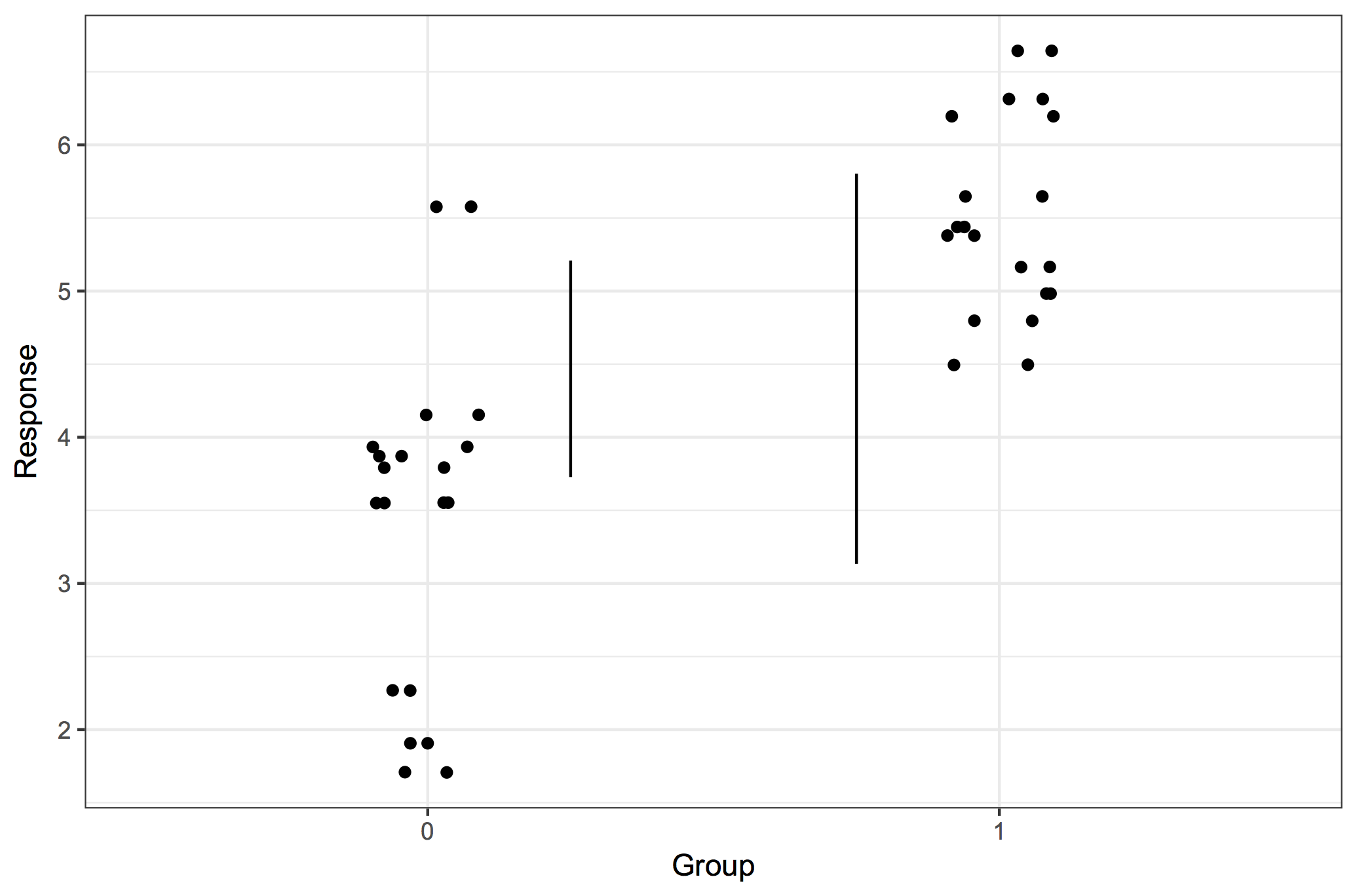
But I had another idea. I am not sure whether it’s a good idea or not, but here it is: We put in the dots, and then we put in two lines that represent the smallest and the greatest difference from the approximate confidence interval:

offset <- (2 * result$estimate[1] + result$estimate[2])/2
shortest <- result$estimate[2] - 2 * result$std.error[2]
longest <- result$estimate[2] + 2 * result$std.error[2]

plot_both <- plot_points + 
    geom_linerange(aes(ymin = offset - shortest/2,
                       ymax= offset + shortest/2,
                       x = 1.25)) +
    geom_linerange(aes(ymin = offset - longest/2,
                       ymax= offset + longest/2,
                       x = 1.75)) +
    theme_bw()

I think it looks pretty good, but it’s not self-explanatory, and I’m not sure whether it is misleading in any way.

Different worlds

Some time ago, I gave a seminar about some work involving chicken combs, and I made some offhand remark about how I don’t think that the larger combs of modern layer chickens are the result of direct selection. I think it is more likely to be be a correlated response to selection on reproductive traits. During question time, someone disagreed, proposing that ornamental traits should be very likely to have been under artificial selection.

I choose this example partly because the stakes are so low. I may very well be wrong, but it doesn’t matter for the work at hand. Clearly, I should be more careful to acknowledge all plausible possibilities, and not speculate so much for no reason. But I think this kind of thing is an example of something quite common.

That is: researchers, even those who fit snugly into the same rather narrow sub-field, may make quite different default assumptions about the world. I suspect, for instance, that we were both, in the absence of hard evidence, trying to be conservative in falling back on the most parsimonious explanation. I know that I think of a trait being under direct selection as a strong claim, and ”it may just be hitch-hiking on something else” as a conservative attitude. But on the other hand, one could think of direct artificial selection as a simpler explanation as opposed to a scenario that demands pleiotropy.

I can see a point to both attitudes, and in different contexts, I’d probably think of either direct selection and pleiotropy as the more far-fetched. For example, I am hard pressed to believe that reductions in fearfulness and changes in pigmentation of domestic animals are generally explained by pleiotropic variants.

This is why I think that arguments about Occam’s razor, burdens of proof, and what the appropriate ”null” hypothesis for a certain field is supposed to be, while they may be appealing (especially so when they support your position), are fundamentally unhelpful. And this is why I think incommensurability is not that outlandish a notion. Sometimes, researchers might as well be living in different worlds.

Various positions

What use is there in keeping a blog if you can’t post your arbitrary idiosyncratic opinions as if you were an authority? Here is a list of opinions about life in the scientific community.

Social media for scientists

People who promote social media for scientists by humblebragging about how they got a glam journal paper because of Twitter should stop. An unknown PhD student from the middle of nowhere must be a lot more likely to get into trouble than get on a paper because of Twitter.

Speaking of that, who thinks that that writing an angry letter to someone’s boss is the appropriate response to disagreeing with someone on Twitter? Please stop with that.

Poster sessions

Poster sessions are a pain. Not only do you suffer the humiliation of not begin cool enough to give a talk, you also get to haul a poster tube to the conference. The trouble is that we can’t do away with poster sessions, because they fulfill the important function of letting a lot of people contribute to the conference so that they have a reason to go there.

Now cue comments of this kind: ”That’s not true! I’ve had some of my best conference conversations at poster sessions. Maybe you just don’t know how to make a poster …” It is true that I don’t know how to make a good poster. Regardless, my ad hoc hypothesis for why people say things like this is that they’re already known and connected enough to have good conversations anywhere at the conference, and that the poster served as a signpost for their colleagues to find them.

How can one make a poster session as good as possible? Try to make lots of space so people won’t have to elbow each other. Try to find a room that won’t be incredibly noisy and full of echos. Try to avoid having some posters hidden behind pillars and in corners.

Also, don’t organize a poster competition unless you also organize a keynote competition.

Theory

There is way way way too little theory in biology education, as far as I can tell. Much like computer programming — a little of which is recognized as a useful skill to have even for empirically minded biologists who are not going to be programming experts — it is very useful to be able to read a paper without skipping the equations, or tell whether a paper is throwing dust when it states that ”[unspecified] Theory predicts …” this or that. But somehow, materials for theory manage to be even more threatening than computer documentation, which is an impressive feat. If you disagree, please post in the comments a reference to an introduction to coalescent theory that is accessible for, say, a biology PhD student who hasn’t taken a probability course in a few years.

Language corrections

That thing when reviewers suggest that a paper be checked by a native English speaker, when they mean that it needs language editing, is rude. Find a way of phrasing it that won’t offend that one native English speaker who invariably is on the paper, but doesn’t have an English enough name and affiliation for you!

Using R: the best thing I’ve changed about my code in years

Hopefully, one’s coding habits are constantly improving. If you feel any doubt about yourself, I suggest looking back at something you wrote 2011.

One thing I’ve changed recently that made my life so much better is a simple silly thing: meaningful name for index and counter variables.

Take a look at these pieces of fake code, that both loop over a matrix of hypothetical data (say: genotypes) to pass each value to a function (that does something):

## First attempt
for (i in 1:ncol(geno)) {
   for (j in 1:nrow(geno)) {
        output[i,j] <- do_something(geno[j, i])
   }
}
## Second attempt
n_markers <- ncol(geno)
n_ind <- nrow(geno)
for (marker_ix in 1:n_markers) {
   for (individual_ix in 1:n_ind) {
        output[individual_ix, marker_ix] <-
            do_something(geno[individual_ix, marker_ix])
   }
}

Isn’t that much nicer? The second version explicitly states what is what: we are iterating over markers and individuals, where each row is an individual and each column a marker. It even helps us spot errors such as the one in the first version. You would marvel at how many years it took me to realise that there is no law that says that the loop variable must be called i.

(Yes, nested for loops and hard bracket indexing looks uglier than a split-apply-combine solution, and using an apply family function would do away with any risk of mixing up the indices. However, loops do look less arcane to the uninitiated, and sometimes in more complicated cases, we really need that loop variable for something else.)

The open access ‘Plan S’ is decisive action to do the wrong thing

Plan S (as Wikipedia puts it: ‘not to be confused with S-plan‘) is an plan by the European Research Council and other European research funders to promote open access publishing. They say that key idea is:

After 1 January 2020 scientific publications on the results from research funded by public grants provided by national and European research councils and funding bodies must be published in compliant Open Access Journals or on compliant Open Access Platforms.

What Plan S is doing right, in my opinion:

  • Research funders have realised that they have weight they can throw around. They can force change on publishers by telling researchers what to and deciding what they will pay for and not pay for.
  • They emphasise copyright and strong licensing (i.e. cc:by) that give readers the rights to use and reproduce.
  • They want publishing costs to be covered by funders, and be capped to be somehow reasonable.

What Plan S is doing wrong, in my opinion, can be summarised by quoting their ninth principle:

The ‘hybrid’ model of publishing is not compliant with the above principles

First, let us talk terminology. ‘Gold’ open access is where the journal is exclusively open access. ‘Green’ is when the journal may not be open access normally, but allows you to put up an accessible copy of the paper somewhere else, for example your friendly institutional repository. These labels unhelpful. They aren’t natural mnemonics, and as you might expect, they are used inconsistently. More importantly, author-pays full open access is not some higher form of publishing, so I wouldn’t call it ‘gold’.

‘Hybrid’ publishing is when only some papers in a journal are open access. This would not be allowed under Plan S. This would prevent publishing in Science, Nature and Cell. Depending on your stance on publishing that may be upsetting or encouraging. Of course, it would also disqualify a set of society journals like Genetics, Heredity, and Evolution.

Why, one might ask? Is it important that open access publishing happens only in exclusively open access journals? I guess the idea is to prevent library-pays journals from getting paid twice by also charging authors for some papers.

I think that is confusing a means with an end. The goal should be to get the most accessible papers with the least amount of effort, and to push scientific publishing in a positive direction. I am not sure that monolithic author-pays publishers are all that much better than monolithic library-pays publishers, so why should we give them a particular advantage?

In my opinion, a better option would be along these lines: We should accept preprints as a form of cheap open access, make sure to format our preprints a bit nicer (I’ve sinned against this by uploading double-spaced manuscripts with the figures at the end), and pressure subscription journals to accept preprinting of the final text without delay. Maybe one could even get journals to accept the preprints to be distributed under permissive licenses. This may be a tall order, but maybe no less realistic than trying to dictate the size of the publishing fee.

We could have the best of both: scientific communities could keep publishing in those quality society journals that all of our colleagues read, and everyone would get free and convenient access to papers. The problem of unreasonable subscription fees will remain, and that needs other plans for joint library and university action. For those of us that have a bit of an iconoclastic streak, it would also leave the field open for new ideas in publishing, rather than prescribing certain journals with a particular business model.

I’m looking at a life unfold
Dreaming of the green and gold
Just like the ancient stone
Every sunrise I know
Those eyes you gave to me
That let me see
Where I come from
(Lianne La Havas)

Journal club of one: ‘Sacred text as cultural genome: an inheritance mechanism and method for studying cultural evolution’

This is a fun paper about something I don’t know much about: Hartberg & Sloan Wilson (2017) ‘Sacred text as cultural genome: an inheritance mechanism and method for studying cultural evolution‘. It does exactly what it says on the package: it takes an image from genome science, that of genomic DNA and gene expression, and uses it as a metaphor for how pastors in Christian churches use the Bible. So, the Bible is the genome, churches are cells, and citing bible passages in a sermon is gene expression–at least something along those lines.

The authors use a quantitative analysis analogous to differential gene expression to compare the Bible passages cited in sermons from six Protestant churches in the US with different political leanings (three conservative and three progressive; coincidentally, N = 3 is kind of the stereotypical sample size of an early 2000s gene expression study). The main message is that the churches use the Bible differently, that the conservative churches use more of the text, and that even when they draw on the same book, they use different verses.

They exemplify with Figure 3, which shows a ‘Heat map showing the frequency with which two churches, one highly conservative (C1) and one highly progressive (P1), cite specific verses within chapter 3 of the Gospel According to John in their Sunday sermons.’ I will not reproduce it for copyright reasons, but it pretty clearly shows how P1 often cites the first half of the chapter but doesn’t use the second half at all. C1, instead, uses verses from the whole chapter, but its three most used verses are all in latter half, that is the block that P1 doesn’t use at all. What are these verses? The paper doesn’t quote them except 3:16 ‘For God so loved the world, that he gave his one and only Son, that whoever believes in him should not perish, but have eternal life’, which is the exception to the pattern — it’s the most common verse in both churches (and generally, a very famous passage).

Chapter 3 of the Gospel of John is the story of how Jesus teaches Nicodemus. Here is John 3:1-17:

1 Now there was a man of the Pharisees named Nicodemus, a ruler of the Jews. 2 The same came to him by night, and said to him, ”Rabbi, we know that you are a teacher come from God, for no one can do these signs that you do, unless God is with him.”
3 Jesus answered him, ”Most certainly, I tell you, unless one is born anew, he can’t see God’s Kingdom.”
4 Nicodemus said to him, ”How can a man be born when he is old? Can he enter a second time into his mother’s womb, and be born?”
5 Jesus answered, ”Most certainly I tell you, unless one is born of water and spirit, he can’t enter into God’s Kingdom. 6 That which is born of the flesh is flesh. That which is born of the Spirit is spirit. 7 Don’t marvel that I said to you, ‘You must be born anew.’ 8 The wind blows where it wants to, and you hear its sound, but don’t know where it comes from and where it is going. So is everyone who is born of the Spirit.”
9 Nicodemus answered him, ”How can these things be?”
10 Jesus answered him, ”Are you the teacher of Israel, and don’t understand these things? 11 Most certainly I tell you, we speak that which we know, and testify of that which we have seen, and you don’t receive our witness. 12 If I told you earthly things and you don’t believe, how will you believe if I tell you heavenly things? 13 No one has ascended into heaven but he who descended out of heaven, the Son of Man, who is in heaven. 14 As Moses lifted up the serpent in the wilderness, even so must the Son of Man be lifted up, 15 that whoever believes in him should not perish, but have eternal life. 16 For God so loved the world, that he gave his one and only Son, that whoever believes in him should not perish, but have eternal life. 17 For God didn’t send his Son into the world to judge the world, but that the world should be saved through him.”

This is the passage that P1 uses a lot, but they break before they get to the verses that come right after: John 3:18-21. The conservative church uses them the most out of this chapter.

18 Whoever believes in him is not condemned, but whoever does not believe stands condemned already because they have not believed in the name of God’s one and only Son. 19 This is the verdict: Light has come into the world, but people loved darkness instead of light because their deeds were evil. 20 Everyone who does evil hates the light, and will not come into the light for fear that their deeds will be exposed. 21 But whoever lives by the truth comes into the light, so that it may be seen plainly that what they have done has been done in the sight of God.

So this is consistent with the idea of the paper: In the progressive church, the pastor emphasises the story about doubt and the possibility of salvation, where Nicodemus comes to ask Jesus for explanations, and Jesus talks about being born again. It also has some beautiful perplexing Jesus-style imagery with the spirit being like the wind. In the conservative church, the part about condemnation and evildoers hating the light gets more traction.

As for the main analogy between the Bible and a genome, I’m not sure that it works. The metaphors are mixed, and it’s not obvious what the unit of inheritance is. For example, when the paper talks about ‘fitness-enhanching information’, does that refers to the fitness of the church, the members of the church, or the Bible itself? The paper sometimes talk as if the bible was passed on from generation to generation, for instance here in the introduction:

Any mechanism of inheritance must transmit information across generations with high fidelity and translate this information into phenotypic expression during each generation. In this article we argue that sacred texts have these properties and therefore qualify as important inheritance mechanisms in cultural evolution.

But the sacred text isn’t passed on from generation to generation. The Bible is literally a book that is transmitted by printing. What may be passed on is the way pastors interpret it and, in the authors’ words, ‘cherry pick’ verses to cite. But clearly, that is not stored in the bible ‘genome’ but somehow in the culture of churches and the institutions of learning that pastors attend.

If we want to stick to the idea of the bible as a genome, I think this story makes just as much sense: Don’t think about how this plasticity of interpretation may be adaptive for humans. Instead, take a sacred text-centric perspective, analogous to the gene-centric perspective. Think of the plasticity in interpretation as preserving the fitness of the bible by making it fit community values. Because the Bible can serve as source materials for churches with otherwise different values, it survives as one of the most important and widely read books in the world.

Literature

Hartberg, Yasha M., and David Sloan Wilson. ”Sacred text as cultural genome: an inheritance mechanism and method for studying cultural evolution.” Religion, Brain & Behavior 7.3 (2017): 178-190.

The Bible quotes are from the World English Bible translation.